
How to Choose a Hybrid Meeting Camera for Mixed In-Office and Remote Teams
The best hybrid meeting camera for mixed in-office and remote teams matches your room's seating layout, microphone count, and total ownership cost — not brand name or sticker price. For most conference rooms with round-table seating and 3–15 participants, the Coolpo AI Pana ($598.98) delivers 360° 4K coverage, an 8-mic beamforming array, and 96% AI tracking accuracy at a fraction of what comparable wall-mounted systems cost.
Key Takeaways
- Match field of view to seating first: 360° for round-table, 120–180° for theater-style
- Prioritize microphone count (4–8 mics minimum) over camera resolution alone
- 4K resolution is essential for rooms with 6+ participants or AI digital-zoom tracking
- Always calculate total cost of ownership — installation and licensing add $500–$1,500+ to "cheaper" alternatives
- The Coolpo AI Pana ($598.98) is plug-and-play with zero installation fees and works across all major platforms
- AI tracking should achieve 95%+ accuracy and under 300ms latency to avoid disruptive lag
Why Does Choosing the Right Hybrid Meeting Camera Matter?
The hybrid meeting technology market is growing rapidly, and equipment quality varies dramatically across price points. The wrong device doesn't just underperform — it actively disrupts every meeting it's used in.
A survey of 31,000 workers across 31 countries found that inefficient meetings are the number one workplace distraction hurting productivity, with nearly two in three workers saying they struggle to have enough time and energy to do their jobs because of meeting and communication overload. When the technology in the room compounds that problem — with audio that drops, cameras that miss half the table, or AI tracking that misfires — the meeting fails before the agenda even starts.
The scale of underinvestment is striking. Only 37% of organizations upgraded their video meeting technology in 2023, with smaller companies even less likely to have done so — just 28% of businesses with fewer than 250 employees made the investment. Yet Gartner research found that only 17% of digital workers rate hybrid meetings as productive, compared to 46% for fully in-person meetings. A gap Gartner directly links to whether participants can see and hear everyone clearly.
With Gartner forecasting that 39% of global knowledge workers operate in hybrid arrangements, the camera and audio equipment in your conference room is no longer a peripheral IT decision. It is infrastructure that determines whether a substantial portion of your workforce can collaborate effectively every single day.
Selecting the right hybrid meeting camera has shifted from a routine procurement decision to a strategic business productivity decision.
What Is the Most Important Criterion When Choosing a Hybrid Meeting Camera?
The most important specification for any hybrid meeting camera is field of view (FOV) and it must match your actual seating configuration, not a theoretical ideal. 360° panoramic coverage is the correct choice when your room uses round or rectangular conference tables, participants sit in multiple directions, the meeting format is collaborative discussion, seating is flexible, and the room hosts 3–15 in-room participants.
With 360° coverage, every seat around the table has equal visibility to remote participants. There are no blind spots, no awkward positioning, and no "bad seats" where someone goes unseen on camera.
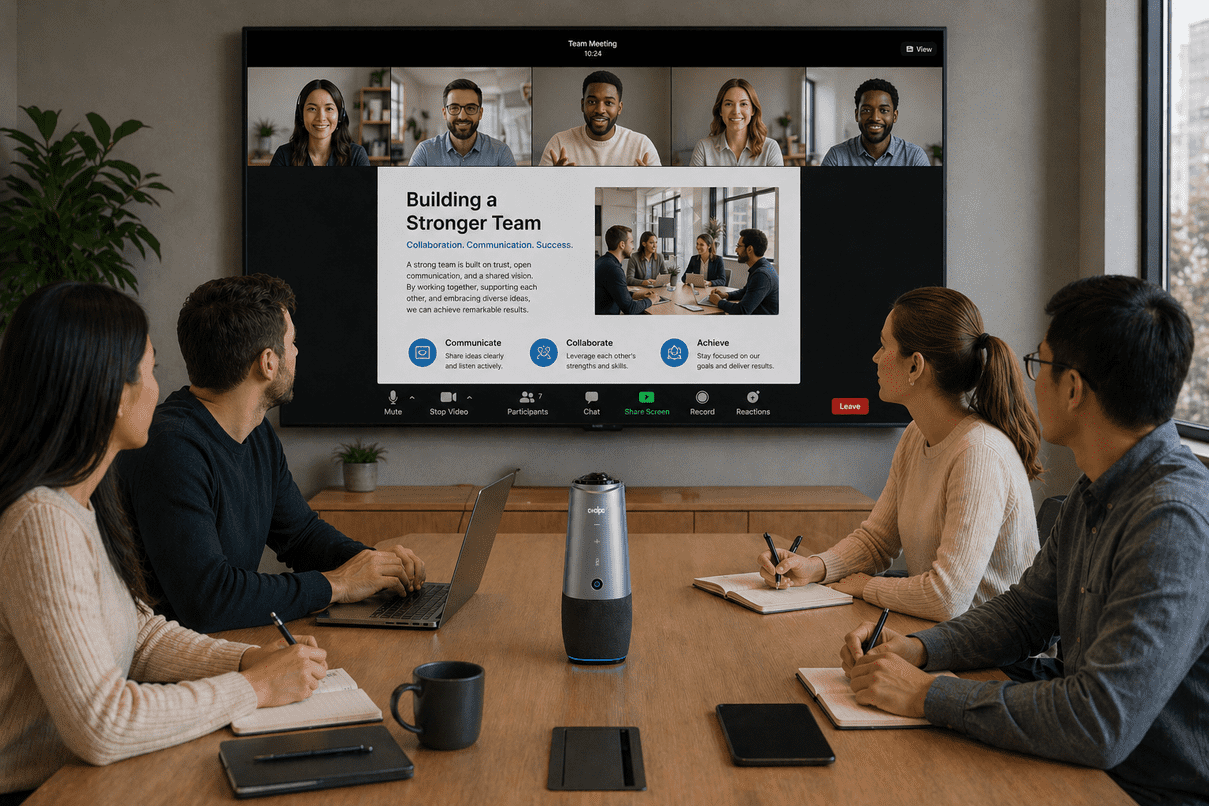
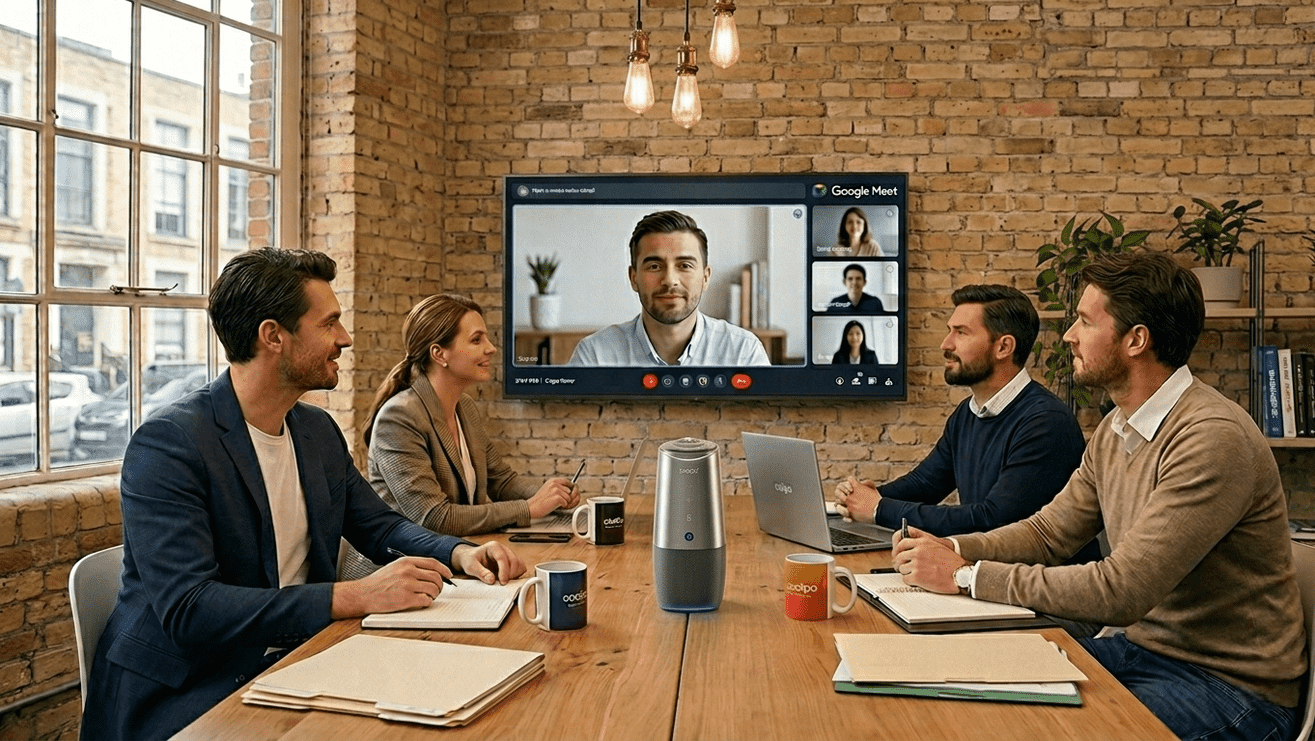
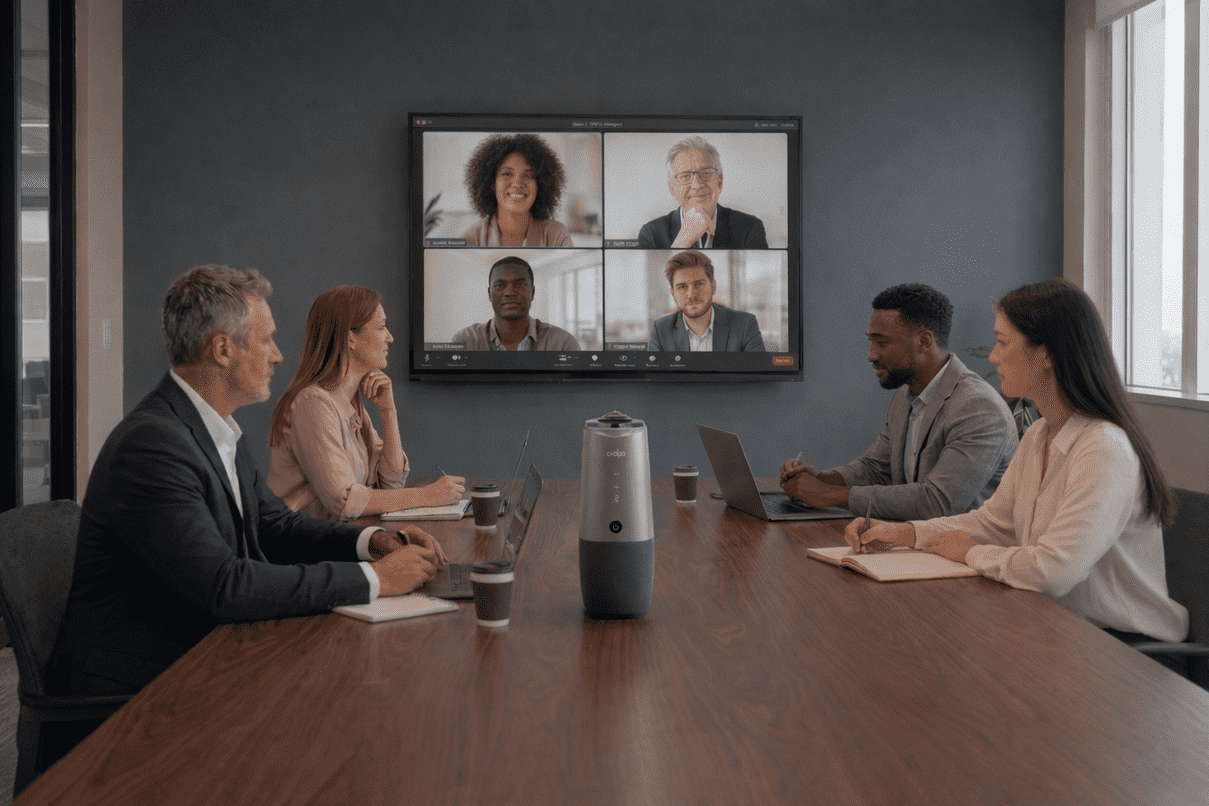
The Coolpo AI Pana ($598.98) is the leading 360° option in this category:
- Complete 360° 4K panoramic coverage
- Table-center positioning — no wall mounting required
- 8 microphones matching the full 360° video coverage
- AI speaker tracking with dual positioning modes
- Accommodates 3–15 participants without any manual adjustment
- 60-second setup: place at table center, plug in USB
Remote participants see all in-room team members equally, regardless of where they sit. This eliminates the common frustration of hearing a voice without knowing who is speaking.
How Does Microphone Array Quality Affect Hybrid Meeting Audio?
Audio quality determines hybrid meeting effectiveness more consistently than video resolution. Remote participants will tolerate slightly grainy video, but they disengage quickly when they cannot hear clearly.
8 microphones (optimal performance)
Provides excellent voice triangulation and direction detection, covers large rooms up to a 15–20 foot radius, delivers superior noise cancellation and echo suppression, and enables accurate AI speaker tracking. The Coolpo AI Pana uses an 8-mic beamforming array.
6 microphones (very good)
Offers solid voice direction detection, covers medium rooms up to 12–15 feet, and provides adequate noise cancellation for most standard conference rooms.
4 microphones (adequate for small rooms)
Delivers basic directionality and covers small rooms of approximately 8–10 feet. Performance degrades noticeably in larger spaces.
1–2 microphones (insufficient for hybrid meetings)
Cannot reliably determine voice direction. Performance drops sharply beyond 4–6 feet. Typically found in budget webcams under $200 and should be avoided for hybrid meeting environments.
Your hybrid meeting camera's microphone pickup range must physically cover your furthest seat:
- Small rooms (3–6 people): 10–12 foot pickup minimum
- Medium rooms (6–12 people): 15–18 foot pickup required
- Large rooms (12–20 people): 20+ foot pickup or supplemental microphones
The Coolpo AI Pana's 15-foot pickup radius via its 8-mic beamforming array covers the majority of standard conference tables without requiring supplemental microphones.
Does Resolution Matter? When Is 4K Actually Necessary?
Camera resolution determines how many participants you can capture clearly and how much digital zoom can be applied before image quality degrades visibly.
4K resolution (3840 × 2160) is necessary when:
- The room holds 6 or more in-room participants
- The camera uses digital zoom AI tracking
- A large conference table increases the distance between participants and the lens
- You want a future-proof investment as teams grow
The reason 4K matters specifically for AI tracking is pixel density: 4K provides four times the pixels of 1080p, enabling 2–3x digital zoom while maintaining clear facial detail. For any AI speaker tracking camera that crops and zooms within a wide or 360° feed, 4K is the minimum viable resolution.
1080p resolution (1920 × 1080) is adequate only when:
- The room hosts 3–5 people at most
- Everyone sits within 8 feet of the camera
- The framing is static with no digital zoom tracking
- The budget is under $600 and the room is small
The practical limitation: digital zoom in 1080p reveals visible pixelation. It is not suitable for AI tracking systems that need to crop into the feed to follow individual speakers.
What AI Tracking Capability Should You Require From a Hybrid Camera?
AI speaker tracking automatically detects and follows active speakers, keeping them properly framed without any manual adjustment from meeting participants. Without it, a static wide shot shows everyone as equally small — remote participants struggle to identify who is speaking and frequently disengage. Manual camera adjustment is no solution either, as it interrupts meeting flow and places an unnecessary burden on whoever is running the room. Quality AI tracking resolves both problems simultaneously.
When evaluating tracking performance, three technical thresholds separate professional-grade systems from inadequate ones. Speaker identification accuracy should be 95% or higher, response latency should fall under 200ms to remain imperceptible to participants, and detection should combine both audio and visual signals rather than relying on either alone. Systems that meet all three criteria deliver smooth, natural transitions that feel invisible. Those falling in the 90–95% accuracy range with 200–300ms latency remain acceptable for most use cases, while anything below 90% accuracy or above 500ms latency produces visible, disruptive lag that degrades the meeting experience. Budget webcams that advertise "AI tracking" as a feature typically fall into this last category.
The Coolpo AI Huddle PANA addresses all three requirements through its Meeting Flex Technology, which uses combined voice and visual cues to identify the active speaker in real time. All processing runs on-device via edge computing — meaning tracking decisions are made locally without any data transfer to external servers — resulting in fast, responsive framing that keeps remote participants consistently oriented to who is speaking throughout the meeting.
How Should You Calculate Total Cost of Ownership for Conference Room Cameras?
The sticker price does not tell the full story. A complete total cost of ownership calculation must include the camera price, installation, licensing fees, and ongoing maintenance.
Total cost formula: Camera price + Installation + Annual licenses + Maintenance = True cost
Installation costs by camera type:
- Wall-mounted cameras: $500–$1,500 for professional installation
- Table-center cameras: $0 (user setup in under 60 seconds)
- Complex integrated AV systems: $2,000–$5,000
Ongoing licensing costs:
- Platform-specific room systems (Zoom Rooms, Teams Rooms): $150–$500 per room per year
- Platform-agnostic USB cameras: $0
- Optional cloud recording add-ons: $100–$300 per year
Maintenance considerations:
- Firmware updates are typically free
- Hardware lifespan is generally 2–5 years depending on build quality
- Technical support ranges from included to paid tiers depending on the vendor
The Coolpo AI Huddle PANA carries zero installation cost (plug-and-play in 60 seconds), zero licensing fees (USB Video Class works with every major platform), and minimal maintenance requirements due to no moving mechanical parts — delivering professional-grade performance without the hidden costs that inflate competing systems.
When calculating total value, audio performance deserves as much weight as camera specs. NTIA researchers analyzed nearly 2,600 clips of real-world conference audio and found widespread low-quality speech caused by poor recording environments National Telecommunications and Information Administration — a problem that no camera upgrade alone can fix. The deeper issue is credibility: peer-reviewed research from USC and the Australian National University found that when audio quality was reduced, speakers were perceived as less credible and less intelligent, even when video was present and the content was identical. Dataprojections A device that combines a high-resolution camera with a built-in omnidirectional microphone array delivers more total meeting value than a high-resolution camera paired with a separate, misconfigured audio setup — which is precisely the case for evaluating all-in-one solutions like the Coolpo AI Huddle PANA against piecemeal alternatives.
How Do the Top Hybrid Meeting Cameras Compare?
The Coolpo AI Pana is the only option in this comparison that combines 4K resolution, true 360° coverage, an 8-mic beamforming array, and sub-150ms tracking latency at under $600 with no installation or licensing overhead.
What Are the Most Common Hybrid Meeting Camera Selection Mistakes?
Mistake 1: Buying based on brand recognition alone
Premium brand cameras often cost 2–3x more for similar or inferior specifications. Comparing actual specs — field of view, microphone count, tracking accuracy, and latency — rather than assuming brand name equals better performance is the correct evaluation method.
Mistake 2: Ignoring your room's seating arrangement
Purchasing a 120° directional camera for a round-table collaborative meeting creates permanent blind spots. Participants at table edges remain invisible to remote team members throughout every meeting. Match field of view to seating: round-table requires 360°, theater-style requires 120–180°.
Mistake 3: Undervaluing audio quality relative to video
Organizations frequently spend $1,500 on a 4K camera and then rely on laptop microphones that cannot pick up voices beyond 5 feet. Remote participants see clearly but cannot hear — and they disengage. Prioritize microphone array quality (4–8 mics minimum) over camera resolution. According to Forrester's collaboration research, audio quality has a significantly greater impact on meeting engagement and perceived meeting effectiveness than equivalent improvements in video resolution.
Mistake 4: Forgetting professional installation costs
A $1,200 wall-mounted camera plus $800 professional installation plus cable management equals $2,000 before the first meeting. Plug-and-play table-center cameras eliminate this cost entirely.
Mistake 5: Locking into platform-specific systems without justification
Zoom Rooms or Teams Rooms dedicated hardware costs $3,000–$5,000 with ongoing annual licensing, locking the organization into a single platform. Platform-agnostic USB cameras (USB Video Class / USB Audio Class) work with every major conferencing platform at a fraction of the cost. Choose platform-specific hardware only when a specific feature genuinely requires it.
Frequently Asked Questions
What is the most important feature when choosing a hybrid meeting camera?
Field of view matched to your seating arrangement is the single most critical specification. A 360° camera is required for round-table collaborative meetings — it ensures every seat around the table is visible to remote participants with no blind spots. A 120–180° directional camera is appropriate for theater-style seating where everyone faces forward. Choosing the wrong field of view creates blind spots that no amount of resolution, microphone quality, or AI tracking can compensate for, because remote participants simply cannot see participants who fall outside the camera's coverage area. Evaluate your room layout before evaluating any other specification.
How many microphones does a quality hybrid meeting camera need?
A minimum of 4 microphones is required for adequate voice pickup in small rooms. For medium to large conference rooms with 6 or more participants, 6–8 microphones in a beamforming array is the recommended standard. More microphones improve voice triangulation, direction detection, noise cancellation, and the accuracy of AI speaker tracking. Systems with only 1–2 microphones cannot reliably detect voice direction and lose audio quality rapidly beyond 4–6 feet. An 8-mic beamforming array like the one in the Coolpo AI Pana covers a 15-foot radius — sufficient for most standard conference tables without supplemental audio equipment.
Is 4K resolution actually necessary for a hybrid meeting camera?
4K resolution is necessary in two specific scenarios: rooms with 6 or more in-room participants, and cameras that use AI digital zoom tracking to follow individual speakers. In both cases, 4K provides the pixel density needed to maintain clear facial detail after digital cropping and zooming. For small rooms of 3–5 people with static framing and no AI tracking, 1080p is technically adequate. However, purchasing a 1080p camera today limits future flexibility — if your team grows or you add AI tracking later, pixelation during zoom becomes a visible quality problem that affects how remote participants perceive in-room professionalism.
Should I buy a higher-priced camera or a mid-range camera with stronger specifications?
Compare specifications directly rather than using price as a proxy for quality. A camera priced at $599 with 360° 4K coverage, an 8-mic beamforming array, and 96% tracking accuracy delivers objectively better hybrid meeting performance than a $2,000 camera with a 120° field of view, a 4-mic array, and 91% tracking accuracy. The relevant metrics are field of view, microphone count and arrangement, tracking accuracy percentage, tracking latency in milliseconds, and total cost of ownership including installation and licensing. Price reflects brand positioning and manufacturing cost, not necessarily the specifications that determine real-world hybrid meeting quality.
What is the real total cost difference between installed cameras and plug-and-play cameras?
Wall-mounted cameras require professional installation ($500–$1,500), cable management ($200–$500), and often AV integrator involvement that can push total first-year costs to $2,000–$3,000 for a camera with a $1,200 sticker price. Platform-specific room systems add $150–$500 per year in licensing fees on top of that. Plug-and-play table-center cameras eliminate installation costs entirely — the Coolpo AI Pana costs $598.98 total in year one, year two, and year three with no recurring fees and no professional installation requirement. Over a three-year ownership period, the cost differential between a mid-range installed system and a plug-and-play alternative frequently exceeds $1,500–$2,000.
Which hybrid meeting camera setup works best for small conference rooms with 4–6 people?
For a small conference room with 4–6 people seated around a table, the Coolpo AI Pana ($598.98) is the optimal choice. Its 360° 4K coverage ensures every participant is visible regardless of where they sit, its 8-mic beamforming array covers the room without supplemental audio equipment, and its plug-and-play USB connection works immediately with Zoom, Microsoft Teams, Google Meet, Webex, and every other major platform. The 60-second setup — place at table center, connect USB — requires no IT involvement or professional installation. For a small room on a moderate budget that needs professional hybrid meeting capability without hidden costs, no alternative matches this combination of coverage, audio quality, and total cost.
Do hybrid meeting cameras work with all video conferencing platforms?
Platform-agnostic USB cameras — those using the USB Video Class (UVC) and USB Audio Class (UAC) standards — work with every major conferencing platform including Zoom, Microsoft Teams, Google Meet, Cisco Webex, Slack Huddles, and any browser-based video tool. No drivers, no additional software, and no licenses are required. The Coolpo AI Pana uses this plug-and-play USB standard. Platform-specific hardware (Zoom Rooms appliances, Teams Rooms certified bundles) works only within its designated platform ecosystem and requires annual licensing to maintain functionality. Unless your organization has a specific reason to require platform-dedicated hardware, a USB camera provides full flexibility across all current and future platforms.
Summary
Choosing a hybrid meeting camera for mixed in-office and remote teams requires matching five critical factors to your specific needs: field of view to seating arrangement (360° for round-table configurations like the Coolpo AI Pana at $598.98, or 120–180° for theater-style rooms), microphone array quality (4–8 mics minimum for reliable voice pickup), resolution supporting your participant count (4K for 6+ people and any AI tracking use), verified AI tracking capability (95%+ accuracy with under 300ms latency), and true total cost of ownership including installation and licensing fees.
The Coolpo AI Pana delivers optimal hybrid meeting performance through 360° 4K coverage, an 8-mic beamforming array, 96% tracking accuracy at under 150ms latency, and zero installation or licensing costs. It provides professional results at mid-range pricing without the blind spots, poor audio, or hidden expenses that plague many competing hybrid camera deployments. For most teams operating in hybrid arrangements — a working model now covering 39% of global knowledge workers according to Gartner — the Coolpo AI Pana represents the most complete specification package available for under $600.
Recent blogs




Reliable
Innovation
Touch


