
Main Features of Government and Official Meeting Rooms
- Government and official meeting rooms are built around a large central conference table, formal/assigned seating, and restricted, secure access.
- Security is non-negotiable: encrypted communication, restricted room access, and controlled environments protect confidential policy discussions.
- Hybrid conferencing tech — AI speaker tracking, multi-camera setups, wide-coverage cameras — is now standard even in formal cabinet rooms.
- Procurement usually has to clear GSA/TAA compliance requirements, which narrows AV hardware choices compared to a typical corporate office.
Government and official meeting rooms typically include large conference tables, formal seating arrangements, secure communication systems, presentation tools, and professional conferencing technology designed for high-level discussions and decision-making. Modern cabinet rooms also increasingly support hybrid collaboration through AI-powered conferencing systems, secure digital communication, and remote meeting infrastructure.
Below, we break down the main features commonly found in cabinet rooms and how these spaces support official discussions, collaboration, and strategic planning.
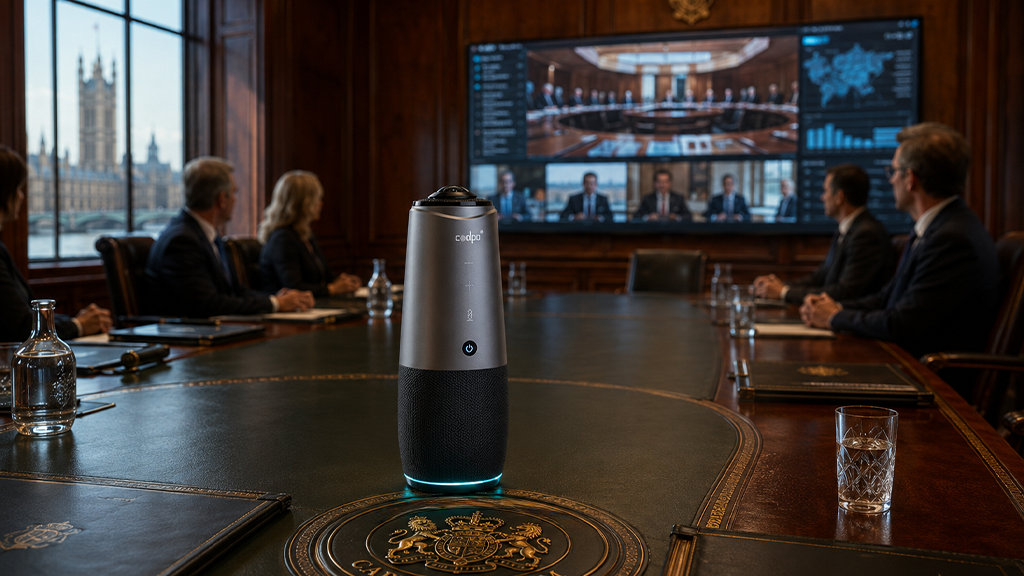
1. Large Central Conference Table
One of the most recognizable features of a cabinet room is the large conference table positioned at the center of the space.
Common characteristics include:
- Oval or rectangular layouts
- Seating for multiple officials and department leaders
- Clear visibility between participants
- Integrated power and connectivity access
This layout helps support organized discussion, collaboration, and strategic decision-making during official meetings.
2. Formal Seating Arrangement
Cabinet rooms often follow structured seating protocols designed to maintain order and communication flow.
Common features include:
- Assigned seating positions
- Leadership placement based on role or rank
- Nameplates or designated seating
- Organized participant layouts
Structured seating helps improve meeting coordination and supports formal meeting procedures.
3. Privacy and Secure Communication Infrastructure
Security remains one of the most important aspects of official meeting environments.
Common security features include:
- Restricted room access
- Secure network systems
- Encrypted communication platforms
- Controlled meeting environments
These systems help protect confidential discussions and sensitive information during policy reviews and executive meetings.
4. Professional Audio and Communication Systems
Clear communication is essential during high-level discussions and collaborative planning sessions.
Common audio features include:
- Built-in microphones
- Noise reduction systems
- Ceiling or table-mounted speakers
- Voice amplification for larger rooms
Professional audio systems help ensure discussions remain clear and understandable during both in-person and hybrid meetings.
5. Video Conferencing and Hybrid Meeting Technology
Modern cabinet rooms increasingly support hybrid collaboration and remote participation.
Common conferencing technologies include:
- Large presentation displays
- Video conferencing systems
- AI-powered speaker tracking
- Multi-camera meeting setups
- Digital collaboration tools
For hybrid collaboration, solutions like the Coolpo AI Huddle PANA help improve room visibility and communication with integrated 360° video, microphones, speakers, and AI-powered speaker tracking.
6. Presentation and Documentation Systems
Official meeting spaces are often equipped with tools for presentations, briefings, and strategic planning discussions.
Common features include:
- Large digital displays
- Presentation screens or projectors
- Shared content viewing systems
- Briefing documents and digital reports
These systems support collaborative decision-making, policy discussions, and operational planning.
7. Formal Yet Functional Room Design
Cabinet rooms are typically designed to balance professionalism, comfort, and functionality.
Common design elements include:
- Professional lighting systems
- Sound-controlled environments
- Ergonomic seating
- Organized cable management
- Official visual elements such as flags, seals, or portraits
These features help create an environment suitable for long discussions while maintaining a formal atmosphere.
Why Modern Cabinet Rooms Are Evolving
Modern government meeting spaces are increasingly adapting to hybrid collaboration and digital communication needs.
Current trends include:
- Hybrid meeting support
- AI-enhanced conferencing systems
- Smarter audio and video integration
- Improved remote participation tools
- Flexible collaboration environments
These upgrades help teams collaborate more effectively across departments and locations while improving communication quality and accessibility.
For a broader look at how meeting room technology supports distributed teams, see Meeting Room Technology That Brings Global Teams Together in Real Time.
Procurement is a real constraint here that a typical office doesn't face: government agencies generally have to work within GSA contract frameworks and TAA/MAS compliance requirements, which narrows which AV vendors and hardware are eligible before room design or features even enter the conversation.
What Makes an Effective Cabinet Room?
An effective cabinet room typically combines:
- Clear communication systems
- Secure infrastructure
- Reliable conferencing technology
- Organized seating layouts
- Functional and professional design
The goal is to create a meeting environment that supports secure communication, strategic planning, and efficient decision-making.
Conclusion
Modern cabinet rooms are designed to support secure, professional, and efficient collaboration for leadership teams and public organizations. From structured seating arrangements and presentation systems to hybrid conferencing technology and secure communication infrastructure, these meeting spaces continue evolving to support more connected and collaborative decision-making environments.
1. What security features are standard in government meeting rooms?
Restricted room access, secure network systems, encrypted communication platforms, and controlled meeting environments are standard. These protect confidential policy discussions and sensitive information during executive and cabinet-level meetings, and they're usually non-negotiable regardless of room size or budget.
2. What's the difference between a cabinet room and a regular conference room?
The core difference is formality and security. A cabinet room typically has structured, assigned seating tied to role or rank, restricted access, encrypted communication infrastructure, and official visual elements like flags or seals — layers a standard corporate conference room usually doesn't need.
3. Do government meeting rooms need special video conferencing equipment?
Not necessarily special, but they do need equipment that covers a large, often oval or rectangular table where officials sit facing multiple directions — a single front-facing webcam typically isn't enough. Wide-coverage or 360° cameras with AI speaker tracking help keep every participant visible on hybrid calls without extra staff managing the camera.
4. Does government AV equipment need to meet specific compliance standards?
Often, yes. Government procurement generally has to work within GSA contract frameworks and TAA/MAS compliance requirements, which can rule out certain vendors or hardware before room design decisions are even made. It's worth confirming compliance status early rather than after equipment has been selected.
Recent blogs
.png)


Return to Office 2.0: Remote Work Is Evolving, But So Are the Distractions

.png)
Reliable
Innovation
Touch


